
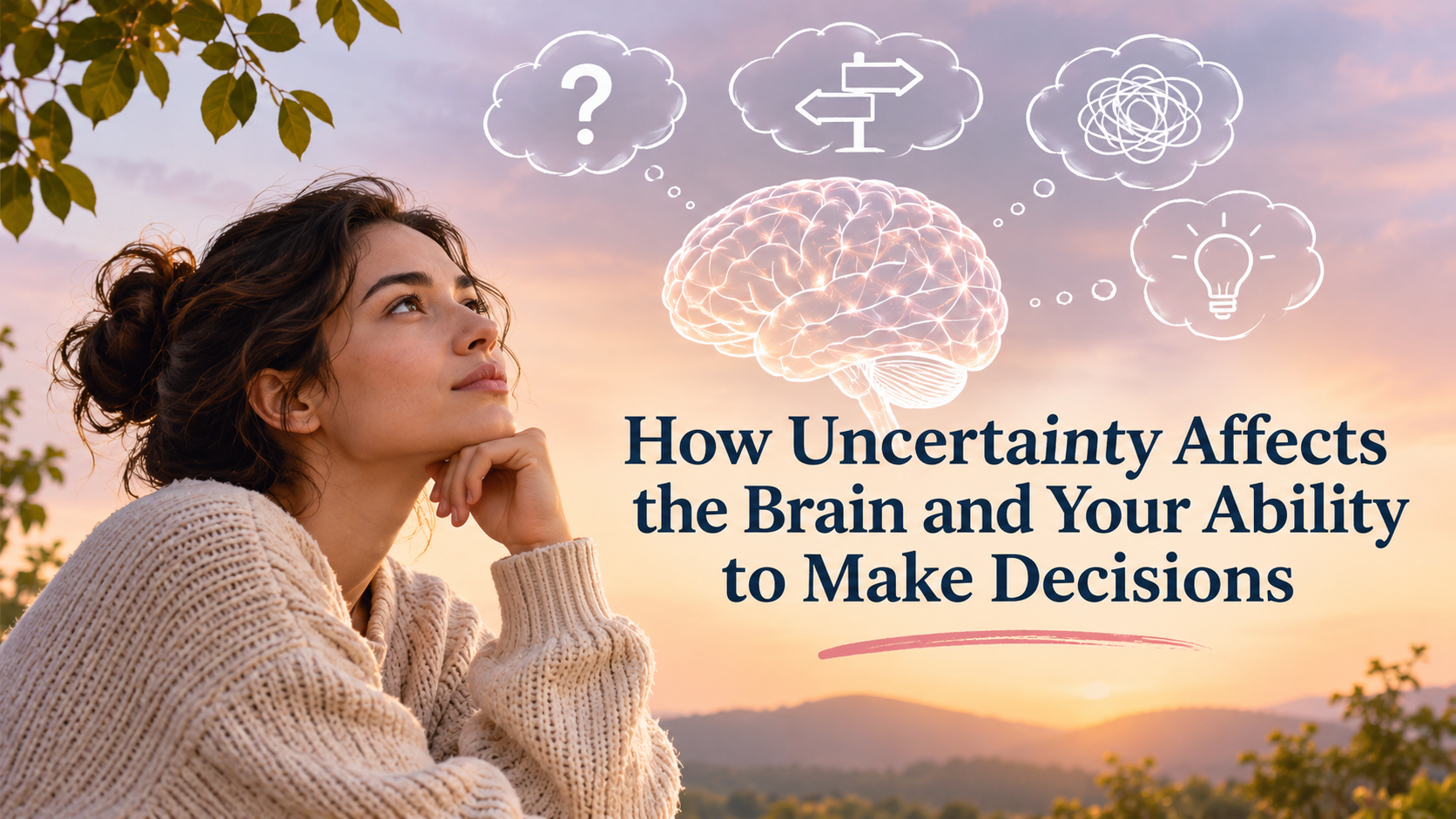
Have you ever found yourself worrying about what might happen next, even when nothing has gone wrong yet? Perhaps you are waiting for an important answer, facing a career change, dealing with relationship problems, or trying to make a decision without knowing how things will turn out.
Uncertainty is a natural part of life, but living with unanswered questions can be mentally exhausting. You may replay different possibilities, imagine negative outcomes, or struggle to choose a direction because you are afraid of making the wrong decision.
This happens partly because the brain constantly tries to understand what is happening and prepare for what comes next. When information is limited, it can become harder to feel secure and make confident choices.
Understanding how uncertainty affects the brain can help you manage anxious thoughts, make decisions more calmly, and develop a healthier relationship with the unknown.

Why Does the Brain Struggle With Uncertainty?
The human brain uses past experiences and available information to anticipate what might happen. Predictability helps us prepare, organize our actions, and respond to potential challenges.
When a situation is uncertain, the brain has fewer reliable clues about what to expect. This can increase alertness and make you pay closer attention to possible risks.
For example, waiting to hear whether you got a job may lead you to repeatedly check your email, imagine different outcomes, and question how the interview went.
Although uncertainty does not always mean danger, your mind may respond as though something needs immediate attention.
How Uncertainty Affects the Brain
1. It Can Activate the Stress Response
When you face an unpredictable situation, your brain may interpret the lack of information as a potential threat.
The amygdala, a brain region involved in processing emotional significance and potential threats, plays a role in these responses. Stress-related systems can also become activated, preparing the body to respond to possible challenges.
You may notice physical and emotional changes such as:
Increased tension or restlessness
Difficulty relaxing
Racing thoughts
Trouble sleeping
Irritability
Constantly anticipating problems
These reactions can make it harder to concentrate on everyday responsibilities.
2. It Can Increase Overthinking
Uncertainty often creates a desire for answers. When clear information is unavailable, you may repeatedly review conversations, search for explanations, or imagine different outcomes.
This can become a cycle:
Something happens that you cannot predict.
You begin searching for possible explanations.
Your mind imagines different outcomes.
You worry about what could go wrong.
You continue searching for certainty.
The problem is that some situations cannot be resolved immediately. Repeated thinking may increase distress without providing new information.
3. It Can Make Decision-Making More Difficult
Making a decision usually involves comparing options and considering possible consequences.
When uncertainty is high, you may struggle to determine which choice is safest or most appropriate. You might delay decisions, repeatedly change your mind, or seek reassurance from others.
For example, deciding whether to change jobs may involve questions about income, career growth, stability, and personal happiness. Without knowing the future, it can feel impossible to choose confidently.
This does not mean you are incapable of making decisions. It may simply mean that stress and fear are making the process feel more demanding.
4. It Can Affect Concentration and Memory
When your attention is occupied by unresolved worries, you may find it harder to focus on other tasks.
You might read the same paragraph several times, forget small responsibilities, or struggle to complete work.
Stress can influence attention and working memory, making it more difficult to hold and process information while trying to manage multiple concerns.
If you are constantly thinking about what might happen tomorrow, it can be difficult to remain present today.
Why Some People Find Uncertainty More Difficult
Everyone experiences uncertainty, but people respond to it differently.
Several factors can influence how comfortable someone feels when answers are unavailable:
Past experiences: Previous disappointments or difficult experiences may make unpredictable situations feel more threatening.
Anxiety: People who experience anxiety may spend more time anticipating negative possibilities.
Perfectionism: The belief that every decision must be correct can make uncertainty harder to tolerate.
Need for control: Feeling responsible for preventing every possible problem can create additional pressure.
Major life changes: Moving, changing jobs, relationship difficulties, or financial concerns can increase feelings of instability.
If uncertainty regularly affects your emotional well-being, exploring Florida online mental health counseling may help you better understand your reactions and develop practical coping strategies.
How to Make Decisions When You Do Not Have All the Answers
You cannot predict every outcome, but you can learn to make thoughtful decisions without waiting for complete certainty.
1. Separate Facts From Assumptions
When you feel overwhelmed, write down what you actually know and what you are imagining.
For example:
Fact: I have not received a response yet.
Assumption: They are going to reject me.
Possibility: They may still be reviewing applications.
Separating information from fear can help prevent imagined outcomes from becoming accepted facts.
2. Focus on What You Can Control
You may not control another person's response, the outcome of an interview, or how quickly a situation changes.
However, you can control how you prepare, what information you gather, and what steps you take next.
Directing your attention toward manageable actions can make uncertain situations feel less overwhelming.
3. Set a Decision Deadline
Repeatedly reconsidering the same choice can increase stress.
For everyday decisions, give yourself a reasonable amount of time to compare options. For more significant choices, identify the information you need and set a date to review your options.
A deadline can help prevent endless analysis.
4. Accept That No Decision Comes With a Guarantee
Even carefully considered choices involve some uncertainty.
Instead of asking, "How can I guarantee this will work?" try asking, "Based on what I know right now, which option best supports my needs and priorities?"
This approach encourages thoughtful action without demanding a perfect outcome.
5. Practice Staying in the Present
When your mind becomes focused on possible future problems, gently bring your attention back to what is happening now.
Try taking a few slow breaths, noticing your surroundings, or completing one small task.
Mindfulness does not eliminate uncertainty. It can help you respond to it without becoming completely consumed by future possibilities.

When Professional Support May Help
Occasional worry about the unknown is a normal human experience. However, if uncertainty causes persistent anxiety, sleep difficulties, avoidance, or problems with everyday decisions, speaking with a mental health professional may be beneficial.
Therapy can help you recognize unhelpful thinking patterns, understand emotional triggers, and develop healthier ways to manage situations you cannot fully control.
Through online therapy and counseling, you can explore virtual support from a familiar environment.
At Let's Talk 4 Health, individuals can learn more about online mental health services and available support options in Florida.
Frequently Asked Questions
Why does uncertainty make me anxious?
Uncertainty can make it difficult to anticipate what will happen next. Your brain may become more alert to possible risks, leading to worry, tension, and repeated thoughts about different outcomes.
Can uncertainty affect my ability to make decisions?
Yes. When you feel stressed or overwhelmed, comparing options and evaluating consequences may become more difficult. You may delay decisions or repeatedly question your choices.
Why do I keep imagining the worst possible outcome?
Your mind may be trying to prepare for potential problems. However, imagining negative possibilities does not mean they will happen. Learning to distinguish realistic risks from anxious predictions can help.
Can therapy help me become more comfortable with uncertainty?
Yes. Therapy can help you explore why uncertainty feels difficult, manage anxious thinking, and develop practical ways to make decisions without needing complete reassurance.
For more information, explore the telehealth therapy FAQs.
Learning to Feel More Comfortable With the Unknown
Uncertainty is unavoidable, but it does not have to control every decision you make. You may not always know what will happen next, and that is part of being human.
Start by focusing on the information you have, identifying what you can influence, and allowing yourself to make reasonable decisions without demanding guarantees.
If worry about the future is affecting your daily life, professional support can help you understand these patterns and find healthier ways to move forward.
Explore online mental health counseling in Florida, learn more about the Let's Talk 4 Health team, or contact the practice to ask about available services.
You do not need to have every answer today. Sometimes, feeling more confident begins with accepting what you cannot know and taking one thoughtful step at a time.
Include a clearer decision-making frameworkReduce repeated uncertainty statements