
Healthy Relationship Habits That Support Mental Wellness
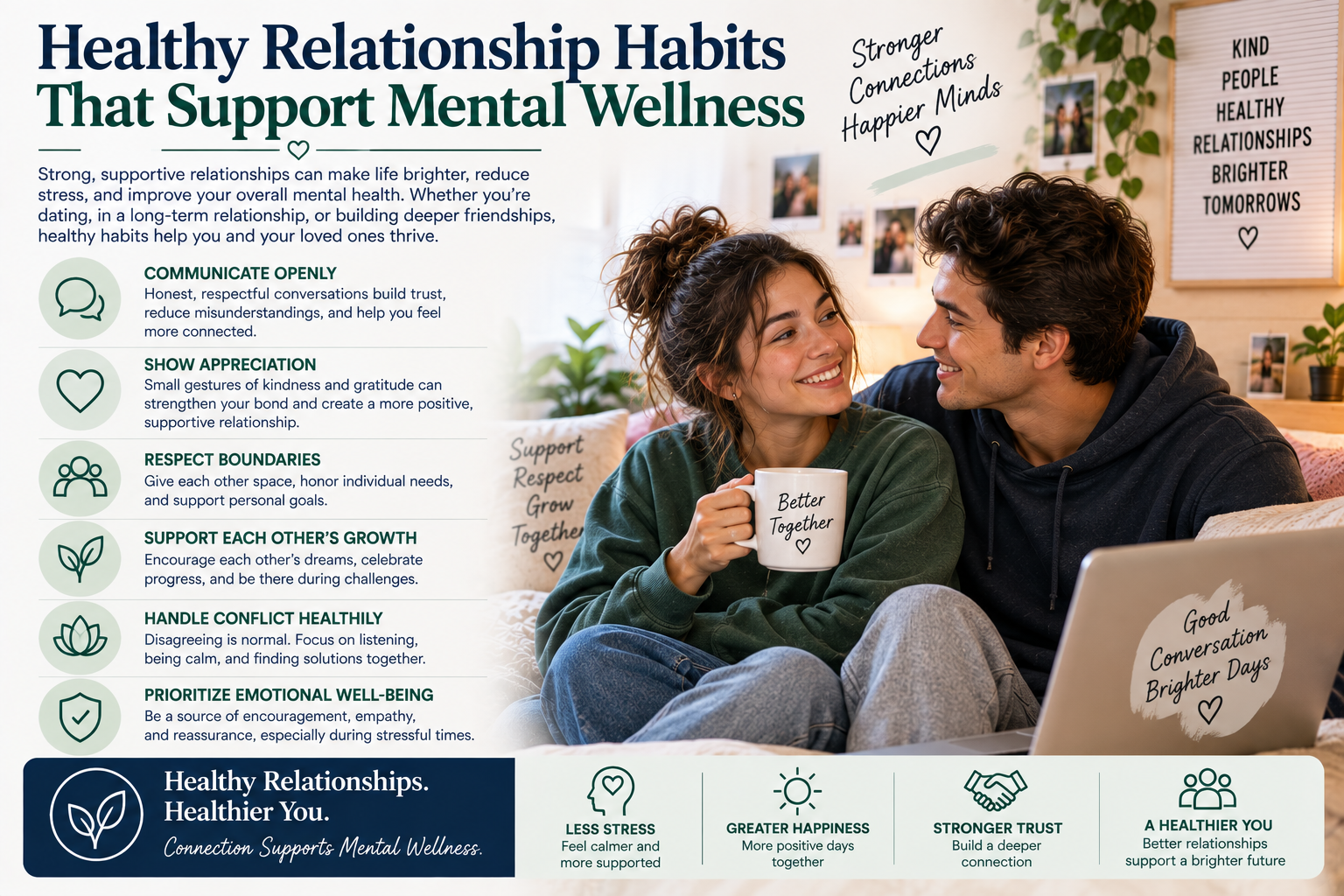
Relationships can be one of the most meaningful parts of life. A supportive partner, close friend, family member, or trusted loved one can make difficult days feel more manageable and good moments feel even more meaningful. At the same time, relationships can also become a source of stress when communication breaks down, boundaries are unclear, emotions are ignored, or one person constantly feels responsible for keeping everything together.
Healthy relationships are not relationships without disagreements. They are relationships where people can communicate honestly, respect one another, repair after conflict, and maintain a sense of individuality while staying emotionally connected.
Mental wellness and relationship health are closely connected. The way we communicate, respond to stress, handle conflict, express affection, and respect boundaries can influence how emotionally safe and supported we feel in everyday life.
At Let’s Talk 4 Health, online mental health counseling can provide a supportive space for individuals and couples who want to understand relationship patterns, improve communication, manage emotional stress, and develop healthier ways of connecting with the people who matter most.
This guide explores practical relationship habits that can support mental wellness and help create stronger, more balanced connections.

What Does a Healthy Relationship Actually Look Like?
People sometimes imagine a healthy relationship as one where two people rarely argue, always agree, or instinctively understand each other.
Real relationships are more complicated.
Two healthy people can have different opinions, different emotional needs, different communication styles, and completely different reactions to stressful situations. The goal is not to eliminate every difference. The goal is to create enough trust and respect that differences can be discussed without destroying the relationship.
A healthy relationship generally includes:
Open communication
Mutual respect
Emotional safety
Reasonable boundaries
Trust
Individual independence
Shared responsibility
Affection and appreciation
The ability to repair after conflict
Space for vulnerability
Support during difficult periods
Respect for each person's needs and limits
These habits can exist in romantic relationships, friendships, family relationships, and other meaningful connections.
Healthy relationships also change over time. What works during one stage of life may not work during another. A couple raising young children may need different communication habits than a couple whose children have left home. Friends may need to adjust when careers, relationships, health concerns, or geographic distance change their routines.
Healthy connection requires flexibility.
Why Relationships Matter to Mental Wellness
Human beings are social creatures. Connection can provide companionship, emotional support, encouragement, perspective, and a sense of belonging.
When relationships feel safe and supportive, people often have someone they can talk to when life becomes difficult. They may also feel more comfortable sharing fears, asking for help, celebrating accomplishments, or simply being themselves.
On the other hand, ongoing relationship conflict can contribute to emotional strain.
For example, someone may begin feeling anxious because they are constantly worried about upsetting their partner. Another person may feel emotionally exhausted because they are always mediating family conflict. Someone else may feel lonely inside a relationship because meaningful conversations have gradually disappeared.
Relationship stress can affect:
Mood
Sleep
Concentration
Confidence
Emotional regulation
Motivation
Stress levels
Sense of security
Overall quality of life
This does not mean every relationship problem causes a mental health condition. It means relationships are part of the environment in which our emotional lives unfold.
Developing healthier relationship habits can therefore be one part of caring for your overall mental wellness.
If relationship stress is contributing to anxiety, sadness, or emotional exhaustion, online mental health counseling in Florida can provide an opportunity to explore what is happening and identify healthier ways forward.
1. Practice Honest Communication
One of the most important habits in a healthy relationship is communicating honestly.
Honest communication does not mean saying every thought the moment it enters your mind. It means being willing to express important feelings, needs, concerns, and expectations rather than consistently hiding them.
Many relationship problems begin with unspoken expectations.
You might think:
"They should know what I need."
"They should realize that hurt me."
"If they really cared, they would understand."
But people cannot reliably read one another's minds.
Even people who love each other deeply can misunderstand each other's intentions.
Instead of expecting someone to automatically know what you need, practice communicating directly.
For example:
Instead of:
"You never help me."
Try:
"I've been feeling overwhelmed lately, and I need more help with some of the responsibilities at home."
Instead of:
"You don't care about me anymore."
Try:
"I've been missing our connection, and I'd like us to spend some intentional time together."
Instead of:
"You're always criticizing me."
Try:
"I feel discouraged when conversations focus mostly on what I did wrong. I'd like us to talk about concerns without putting each other down."
Honest communication gives the other person useful information.
Communication Is More Than Talking
Healthy communication also involves listening.
Listening means giving another person enough attention to understand what they are actually trying to say.
You do not necessarily have to agree.
You can understand someone's perspective without accepting their conclusion.
A useful habit is to pause before responding.
Ask yourself:
What are they actually trying to communicate?
What emotion might be underneath their words?
Am I listening to understand or preparing my defense?
Do I need clarification before responding?
Is this the right moment to solve the problem?
Sometimes people need emotional acknowledgment before they need advice.
A simple statement such as "I can understand why that was difficult for you" can help someone feel heard.
2. Learn to Express Needs Without Blame
Healthy relationships require people to communicate their needs.
However, how you express those needs matters.
Blame tends to put the other person into a defensive position.
Statements beginning with "you always" or "you never" can quickly turn a conversation into an argument.
Try using language that describes your experience.
For example:
"I feel disconnected when we don't have time to talk."
"I feel anxious when plans change without communication."
"I need some quiet time after work before we talk about difficult subjects."
"I would appreciate more help with this."
This does not guarantee that the other person will respond exactly how you want. It simply creates a healthier starting point for the conversation.
3. Make Emotional Check-Ins a Habit
Healthy relationships benefit from regular emotional check-ins.
You do not have to wait until something is seriously wrong before asking how someone is doing.
A simple:
"How have you really been feeling lately?"
can open a meaningful conversation.
For couples, emotional check-ins might happen once or twice a week.
For friends, it might mean occasionally moving beyond casual conversation.
For families, it could mean creating a regular opportunity for everyone to talk.
The goal is not to turn every interaction into therapy.
The goal is to prevent emotional distance from becoming invisible.
Try asking:
How have you been feeling lately?
Is there anything you've been carrying that you haven't talked about?
Is there anything you need more of right now?
Is there anything that has been bothering you?
How can I support you?
How are we doing as a relationship?
These questions communicate something powerful:
Your emotional experience matters to me.
4. Respect Personal Boundaries
Boundaries are essential to healthy relationships.
A boundary is not a punishment or a wall. It is a clear statement about what you are comfortable with, what you need, and what you are willing or unwilling to participate in.
Healthy boundaries can involve:
Personal space
Communication
Time
Physical affection
Privacy
Money
Family involvement
Work-life separation
Social commitments
Emotional responsibilities
For example, someone might say:
"I don't want to discuss this while we're both angry. I'd like to take some time and come back to the conversation later."
Another person might say:
"I care about you, but I can't be available to talk every night."
Someone else might say:
"I need some time alone this weekend."
Boundaries allow relationships to contain both connection and individuality.
Boundaries Are Not Rejection
One common misunderstanding is that needing space means you do not care.
It does not.
People need different amounts of solitude and connection.
One partner may recharge by talking. Another may need quiet.
One friend may enjoy daily communication. Another may prefer occasional conversations.
Neither automatically means one person cares more.
Healthy relationships make room for differences.
If setting boundaries creates intense guilt, fear, or anxiety, exploring those feelings can be valuable. Therapy and counseling services can help individuals understand why certain boundaries feel difficult and practice communicating them more confidently.
5. Maintain Your Individual Identity
A healthy relationship should not require you to stop being yourself.
When people become deeply connected, it is natural for routines and interests to overlap. But maintaining some individuality can support emotional balance.
Continue making space for:
Your hobbies
Your friendships
Your personal goals
Your interests
Your values
Your alone time
Your professional development
Your creative activities
A relationship can be an important part of your identity without becoming your entire identity.
This matters for mental wellness because having multiple sources of meaning can create a broader emotional foundation.
If every part of your emotional life depends on one person, relationship difficulties can feel overwhelming.
Maintaining individual interests does not weaken intimacy. In many cases, it gives people more experiences, perspectives, and energy to bring back into the relationship.
6. Practice Appreciation Regularly
People often notice what is wrong more quickly than what is right.
A missed responsibility can become the focus of an entire evening, while dozens of ordinary acts of kindness go unnoticed.
Making appreciation intentional can help shift attention.
Tell people when you appreciate them.
You could say:
"Thank you for checking on me."
"I really appreciated what you did today."
"I love how patient you were with the kids."
"Thank you for listening."
"I'm glad you're in my life."
Appreciation does not have to be dramatic.
Small acknowledgments can become part of the emotional atmosphere of a relationship.
Why Specific Appreciation Matters
Instead of simply saying "you're great," be specific.
"I appreciated that you remembered something important to me."
"I noticed how much effort you put into that."
"Thank you for giving me space when I needed it."
Specific appreciation shows that you are paying attention.
And being noticed is an important part of feeling connected.
7. Learn How to Disagree Without Becoming Enemies
Disagreement is normal.
The way people disagree is what often determines whether conflict becomes constructive or destructive.
Healthy disagreement allows two people to remain on the same team even when they have different opinions.
Try to avoid:
Personal insults
Name-calling
Threats
Mocking
Bringing up unrelated past mistakes
Deliberately humiliating someone
Refusing to communicate as punishment
Trying to "win" at all costs
Instead, focus on the issue.
You can say:
"We see this differently."
"I understand your perspective, but I don't agree."
"Can we slow this conversation down?"
"I don't want this to become a fight. I want us to understand each other."
That last distinction is important.
The purpose of many relationship conversations should not be to determine who is right.
It should be to understand what each person needs and determine what can realistically change.
8. Know When to Take a Break During Conflict
Sometimes the healthiest thing you can do during an argument is pause.
When emotions become intense, people may say things they do not mean or become focused on defending themselves rather than listening.
Taking a break can give both people time to regulate.
But there is an important difference between taking a healthy pause and using silence as punishment.
A healthy pause communicates:
"I am too overwhelmed to have this conversation productively right now. I need some time, and I'd like to continue later."
An unhealthy withdrawal might communicate:
"I'm going to ignore you until you suffer enough."
The first creates space for regulation.
The second creates uncertainty and emotional distress.
If you take a break, whenever possible, establish that the conversation will be revisited.
9. Practice Emotional Regulation
Healthy relationships require emotional regulation.
You cannot always control what emotion appears, but you can work on how you respond to it.
Anger, jealousy, disappointment, fear, sadness, and frustration are normal human emotions.
The goal is not to eliminate them.
The goal is to respond without automatically acting on every emotional impulse.
Before responding during a difficult conversation, try:
Taking several slow breaths
Drinking water
Walking briefly
Sitting somewhere quiet
Writing down your thoughts
Waiting until you feel calmer
Naming the emotion you're experiencing
You might say:
"I'm feeling really frustrated right now, and I don't want to respond in a way I'll regret."
That level of awareness can change the direction of a conversation.
10. Stop Expecting One Person to Meet Every Emotional Need
A romantic partner can be deeply important without being responsible for every emotional need you have.
Friends, family, community, hobbies, work, personal interests, and professional support can all play different roles.
For example, you might talk to a friend about a shared hobby, a family member about a family experience, and a therapist about deeper emotional patterns.
This does not diminish the importance of your relationship.
It creates a healthier support system.
People often feel less pressure when emotional support is distributed across several healthy sources.
11. Protect Quality Time
Being physically close does not always mean being emotionally connected.
Two people can sit in the same room while both stare at their phones and barely interact.
Quality time involves attention.
It does not have to involve expensive dates or elaborate plans.
Quality time can be:
Taking a walk
Cooking together
Having coffee
Watching a show together
Going for a drive
Talking before bed
Sharing a meal
Playing a game
Sitting outside
Exploring a new place
The important element is intentional connection.
Even a short period of focused attention can feel different from simply being in the same space.
12. Put Away the Phone Sometimes
Technology makes connection easier, but it can also interrupt connection.
Constant notifications can make conversations feel fragmented.
Try creating small technology-free periods.
For example:
During meals
During important conversations
During the first few minutes after arriving home
Before bed
During a weekly date or quality-time period
This does not need to become a strict rule.
The point is to communicate:
"When we're together, I want to be present."
13. Talk About Expectations
Many relationship conflicts come from expectations that were never discussed.
People may have different assumptions about:
Household responsibilities
Money
Family involvement
Social activities
Communication frequency
Alone time
Parenting
Career priorities
Holidays
Friendships
Physical affection
Future goals
Talking about expectations can prevent misunderstandings.
For example:
"What does a balanced household look like to each of us?"
"How much alone time do we each need?"
"How should we handle disagreements?"
"What does quality time mean to you?"
"What kind of support do you want when you're stressed?"
These conversations may feel awkward initially, but they can create clarity.
14. Learn Each Other's Stress Signals
People do not always say "I'm overwhelmed."
Stress may appear as:
Irritability
Withdrawal
Silence
Restlessness
Trouble sleeping
Difficulty concentrating
Increased sensitivity
Overworking
Avoidance
Learning to recognize these signs can improve communication.
Instead of immediately assuming someone is angry with you, consider asking:
"You seem like you've had a difficult day. Do you want to talk or have some space?"
That question gives the other person choices.
15. Avoid Mind Reading
Mind reading is the assumption that you know what another person thinks or feels without checking.
Examples include:
"They're ignoring me because they're angry."
"They didn't call because they don't care."
"They're quiet because I did something wrong."
Sometimes the assumption is correct.
Sometimes it is completely wrong.
Instead of filling in the blanks, ask.
"Is something bothering you?"
"Did I misunderstand what you meant?"
"Are you upset with me, or are you just having a difficult day?"
Clarification can prevent hours of unnecessary worry.
16. Repair After Conflict
One of the most important relationship skills is repair.
Healthy relationships are not defined by never hurting each other.
They are defined partly by what happens after someone gets hurt.
Repair might involve:
Apologizing
Acknowledging what happened
Taking responsibility
Explaining without making excuses
Listening to the other person's experience
Changing the behavior
Reconnecting afterward
A meaningful apology is more than "I'm sorry you feel that way."
It might sound like:
"I'm sorry I spoke to you that way. I was frustrated, but that doesn't make it okay. I understand why it hurt you."
Then comes the harder part:
Changing the behavior.
Words matter, but consistent actions build trust.
17. Take Responsibility for Your Part
Healthy relationships require accountability.
This does not mean accepting blame for everything.
It means being willing to recognize your contribution when you have made a mistake.
Ask yourself:
"What was my part in this?"
"Did I communicate clearly?"
"Did I react instead of respond?"
"Did I dismiss their feelings?"
"Was I carrying stress from somewhere else into this conversation?"
Accountability can feel uncomfortable, but it can also be freeing.
You cannot control another person's behavior.
You can work on your own.
18. Stop Keeping Score
Relationships are not always perfectly equal every day.
There may be weeks when one person carries more responsibility because the other is sick, stressed, traveling, or overwhelmed.
Problems arise when relationships become a constant calculation:
"I did this, so you owe me that."
"I called last time, so you should call this time."
"I apologized first, so now you need to apologize."
Healthy relationships generally involve mutual care rather than constant scorekeeping.
At the same time, repeated one-sidedness should not be ignored.
There is a difference between temporary imbalance and a relationship where one person consistently does all the emotional work.
19. Build Trust Through Consistency
Trust is often built through small actions.
Doing what you said you would do.
Showing up when you promised.
Being honest about mistakes.
Respecting private information.
Following through.
Communicating when plans change.
Consistency gives people evidence that your words and actions generally match.
Trust rarely develops from one grand gesture.
It develops over time.
20. Be Honest About What You Can Give
Sometimes people say yes because they are afraid of disappointing others.
Eventually, they become exhausted or resentful.
Learning to say:
"I can't do that right now."
"I don't have the capacity for that today."
"I need some time before I can help."
is a healthy relationship habit.
Honesty about capacity prevents promises you cannot realistically keep.
It also allows other people to make informed decisions about their own needs.
21. Make Room for Vulnerability
Emotional intimacy requires some vulnerability.
Vulnerability can mean saying:
"I'm scared."
"I'm not sure what to do."
"I've been struggling lately."
"I need help."
"I felt hurt by what happened."
These statements can feel risky.
But relationships cannot become deeply connected if everyone constantly hides what is happening internally.
Vulnerability should be reciprocal and respectful. Nobody should be pressured into sharing more than they are ready to share.
Vulnerability Does Not Mean Oversharing
Healthy vulnerability has boundaries.
You can choose what to share, when to share it, and with whom.
A relationship should not require you to reveal every thought or experience.
Privacy and vulnerability can coexist.
22. Respect Differences
Healthy relationships do not require identical personalities.
You may have different:
Political opinions
Hobbies
Energy levels
Social preferences
Family traditions
Communication styles
Financial habits
Career goals
Differences become a problem when they are treated as proof that the other person is wrong, inferior, or unworthy of respect.
Ask:
"Can we disagree and still respect each other?"
"Is this actually a problem, or simply a difference?"
"Do we need agreement, or do we need understanding?"
Those questions can prevent unnecessary conflict.
23. Learn Your Relationship Patterns
Most people bring patterns from earlier relationships and experiences into current relationships.
You may have learned to:
Avoid conflict
Over-explain yourself
Become quiet when upset
Seek reassurance repeatedly
Assume rejection
Take responsibility for everyone
Become defensive
Hide emotions
Please others
Distance yourself when vulnerable
These patterns often develop for understandable reasons.
The challenge is recognizing when an old protective strategy no longer serves you.
Therapy can provide a space to explore these patterns without judgment. Through online counseling and mental health support, individuals can work on emotional awareness, communication, boundaries, and relationship concerns from the comfort of home.
24. Don't Confuse Anxiety With Intuition
Sometimes anxiety can make uncertainty feel like danger.
You might think:
"They haven't responded. Something must be wrong."
"They seem different today. They must be upset with me."
"They want to spend time alone. Maybe they don't love me anymore."
The feeling is real.
The conclusion may not be.
Before reacting, ask:
"What do I know?"
"What am I assuming?"
"What other explanations are possible?"
"What evidence do I actually have?"
This distinction can help reduce unnecessary relationship anxiety.
25. Give Reassurance Without Creating Dependence
Reassurance can be healthy.
If someone you love is struggling, saying "I'm here for you" can be meaningful.
However, relationships can become exhausting when one person requires constant reassurance and the other feels responsible for regulating every emotional fluctuation.
A healthier approach combines reassurance with personal coping skills.
For example:
"I love you, and we're okay. I also know this situation is making you anxious. What might help you feel grounded right now?"
This communicates support without making one person entirely responsible for another person's emotional state.
26. Make Mental Health Conversations Normal
Mental health should not only be discussed when someone reaches a crisis point.
You can normalize conversations about:
Stress
Anxiety
Burnout
Sadness
Grief
Loneliness
Emotional exhaustion
Major life changes
Ask:
"How are you coping?"
"Have you been sleeping okay?"
"Is work becoming overwhelming?"
"Do you feel like you have enough support?"
These questions can make it easier for people to seek help earlier.
If you or someone you care about is struggling with emotional concerns, Let’s Talk 4 Health offers online mental health support designed to make counseling more accessible.
27. Understand That Support Does Not Mean Fixing
When someone shares a problem, many people immediately start looking for solutions.
But sometimes people want to be heard before they want advice.
Try asking:
"Do you want me to listen, or do you want help figuring out what to do?"
That one question can prevent many misunderstandings.
Sometimes the most supportive thing you can say is:
"That sounds really hard."
"I'm here."
"You don't have to figure everything out tonight."
"You make sense to me."
Emotional support does not always require a solution.
28. Create Healthy Conflict Rules
Every relationship can benefit from basic conflict agreements.
For example:
We won't insult each other.
We won't threaten the relationship during every disagreement.
We can ask for a break.
We will return to important conversations.
We won't intentionally embarrass each other.
We will focus on the current issue.
We will listen before responding.
We will apologize when necessary.
These agreements create structure when emotions are high.
29. Don't Ignore Repeated Patterns
One disagreement does not necessarily define a relationship.
Repeated patterns deserve attention.
For example:
The same argument happens every week.
One person always apologizes.
One person avoids every difficult conversation.
Boundaries are repeatedly ignored.
Communication becomes increasingly hostile.
One person feels constantly responsible for the other's emotions.
Emotional distance continues despite attempts to reconnect.
When a pattern continues, simply trying harder may not be enough.
This is where professional support can be helpful.
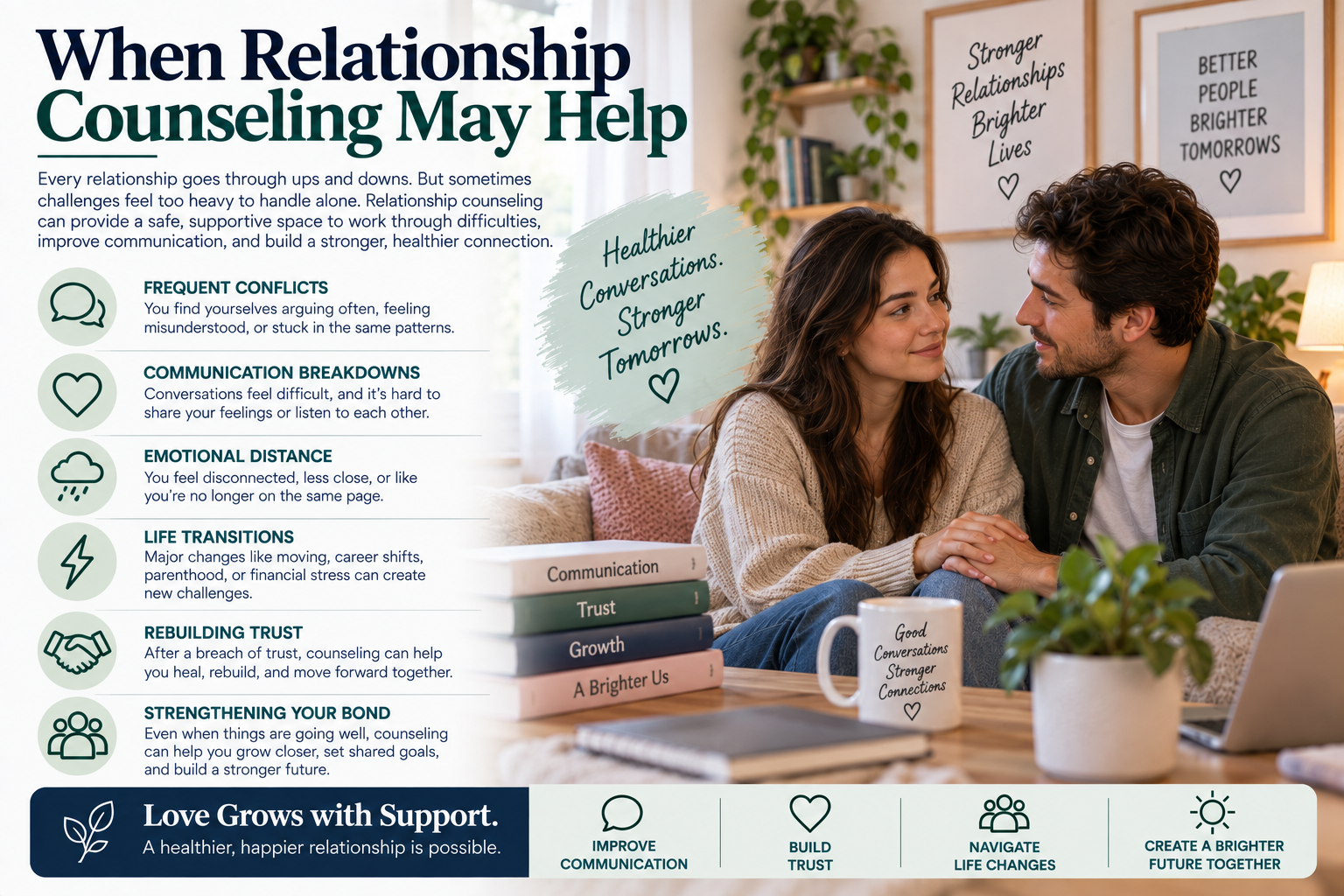
When Relationship Counseling May Help
You do not have to wait until a relationship is falling apart to seek support.
Counseling may be useful when you are experiencing:
Persistent communication problems
Frequent conflict
Emotional distance
Difficulty rebuilding trust
Major life transitions
Parenting disagreements
Repeated misunderstandings
Anxiety connected to relationships
Difficulty establishing boundaries
Unresolved resentment
Challenges following a major breach of trust
The goal of counseling is not necessarily to tell someone what decision to make about their relationship.
It can provide a structured environment for understanding emotions, identifying patterns, improving communication, and considering healthier options.
Healthy Relationships and Self-Worth
Your relationship with yourself influences many of your other relationships.
If you consistently believe your needs do not matter, you may have difficulty communicating them.
If you believe you must be perfect to be loved, mistakes may feel terrifying.
If you believe conflict automatically means abandonment, ordinary disagreements may feel much more threatening.
Developing self-respect can therefore support relationship health.
This may include learning to say:
"My feelings matter."
"I can make mistakes and still deserve respect."
"I can care about someone without agreeing with them."
"I can set a boundary without being cruel."
"I can ask for help."
"I don't have to earn my right to have needs."
These beliefs can take time to develop, especially if previous experiences taught you something different.
Healthy Relationship Habits for Couples
Couples often benefit from making connection intentional.
Consider creating a simple weekly relationship check-in.
Set aside 20 to 30 minutes and discuss:
What went well?
Share something you appreciated about the relationship.
What felt difficult?
Discuss one concern without turning it into a list of every problem from the past year.
What do you need?
Each person gets an opportunity to describe something they need emotionally or practically.
What can we do differently?
Choose one realistic change.
What are we looking forward to?
End with something positive, such as a weekend activity, shared goal, or personal accomplishment.
The purpose is not perfection.
It is maintenance.
Relationships, like many important parts of life, benefit from regular attention.
Healthy Relationship Habits for Friendships
Friendships deserve intentional care too.
Adult friendships can become difficult to maintain because of work, parenting, geographic distance, relationships, and changing schedules.
Healthy friendship habits include:
Checking in even when life is busy
Celebrating each other's accomplishments
Being honest when something feels wrong
Respecting different communication styles
Avoiding one-sided emotional dependence
Making plans when possible
Forgiving reasonable mistakes
Respecting boundaries
Allowing friendships to evolve
You do not have to talk every day to have a meaningful friendship.
Consistency and mutual care matter more than constant contact.
Healthy Relationship Habits for Families
Family relationships can be especially complicated because people often have long histories together.
Old roles can continue even after everyone has changed.
A parent may continue treating an adult child like a teenager.
Siblings may fall back into childhood conflict patterns.
Adult family members may struggle to establish boundaries.
Healthy family relationships often require recognizing that everyone is capable of change.
Try communicating as adults.
Instead of:
"You've always been like this."
Try:
"When this happens now, I feel..."
Instead of:
"You never listen."
Try:
"I'd like to finish what I'm saying before we respond to each other."
Small changes in communication can gradually change family dynamics.
What Healthy Relationships Do Not Require
A healthy relationship does not require:
Constant availability
Perfect communication
Agreement on everything
Giving up your identity
Ignoring your own needs
Avoiding every disagreement
Always being happy
Solving another person's mental health struggles
Accepting disrespect
Proving your love through exhaustion
Love and boundaries can coexist.
Compassion and accountability can coexist.
Independence and intimacy can coexist.
When a Relationship Is Causing Significant Emotional Harm
Healthy relationship habits can improve ordinary relationship difficulties, but they are not a solution for every situation.
If a relationship involves intimidation, threats, coercion, violence, stalking, manipulation, or ongoing abuse, the situation requires a different kind of support.
Safety should come first.
Someone experiencing abuse may need specialized domestic violence resources, legal guidance, crisis support, or a personalized safety plan.
It is important not to frame serious abuse simply as a communication problem where both people need to "try harder."
Building a Relationship That Supports Mental Wellness
A mentally supportive relationship does not remove every difficult emotion from your life.
Instead, it can provide a place where emotions can be acknowledged.
You can have a difficult day and still feel loved.
You can disagree and still feel respected.
You can ask for space without fearing punishment.
You can admit that you made a mistake without believing you are worthless.
You can say you need help without feeling ashamed.
You can celebrate something good without worrying that your happiness will be minimized.
That kind of emotional environment can become an important part of overall well-being.
A Simple Daily Relationship Practice
If you want to begin strengthening your relationships, you do not need to change everything at once.
Try this five-minute practice.
Step 1: Notice
Think about someone important to you.
Step 2: Appreciate
Identify one thing you genuinely appreciate about them.
Step 3: Connect
Send a message, make a call, give them your attention, or simply tell them what you appreciate.
Step 4: Listen
If they respond, give them space to share without immediately trying to fix everything.
Step 5: Reflect
At the end of the day, ask yourself:
"Did I communicate in a way that reflected the kind of relationship I want?"
This is a small practice, but healthy relationships are often built through small repeated actions.
When You Feel Like You Are Always the One Trying
Sometimes people read articles about healthy relationships and immediately think:
"I'm already doing all of this. The other person isn't."
That feeling deserves attention.
Relationships require mutual participation.
You can improve your communication, regulate your emotions, establish boundaries, and become more aware of your patterns. But you cannot single-handedly create a healthy dynamic with someone who consistently refuses respect, communication, accountability, or boundaries.
This is one reason individual therapy can be valuable even when your concern is primarily about a relationship.
You can focus on what is within your control.
You can explore:
Why certain behaviors affect you so strongly
What you need from relationships
Which boundaries matter
How you communicate under stress
What patterns you repeatedly experience
How to respond differently
How to care for yourself during relationship difficulties
Online mental health counseling can make this kind of support available without requiring you to rearrange your entire schedule around an office visit.
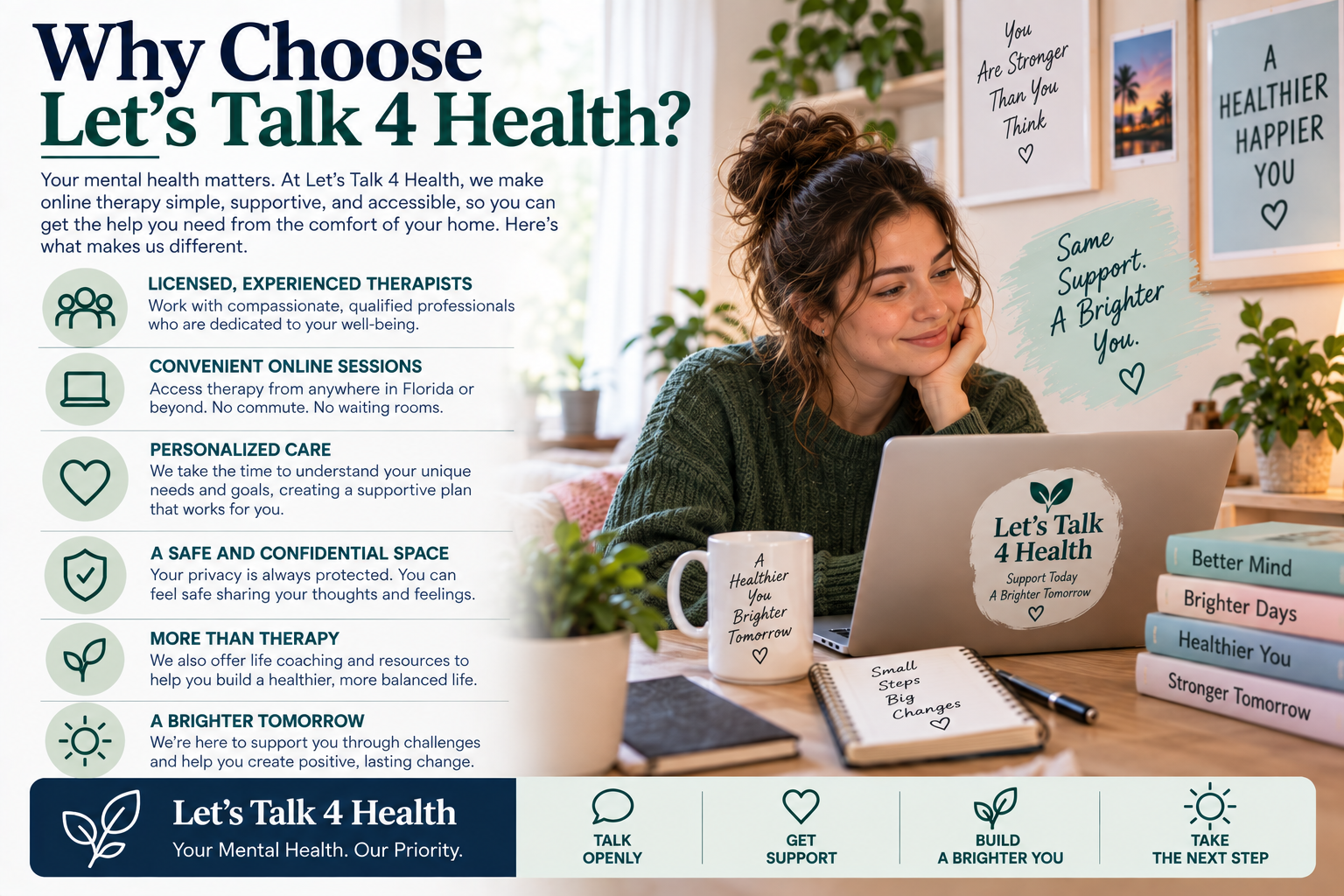
Why Choose Let’s Talk 4 Health?
Relationship concerns rarely exist in isolation.
Stress at work can affect communication at home. Anxiety can influence how someone interprets a partner's behavior. Burnout can reduce emotional availability. Grief can change family dynamics. Major transitions can challenge even strong relationships.
At Let’s Talk 4 Health, counseling can provide a confidential and supportive environment to explore these interconnected concerns.
Michelle Albo, LMHC, MCAP, CTP, brings more than 35 years of experience to her work with clients. The focus is on creating a supportive environment where individuals can better understand themselves, work through emotional challenges, and develop healthier ways of coping and connecting.
Whether you are dealing with relationship stress, anxiety, emotional exhaustion, life changes, or other mental health concerns, Florida online mental health counseling can provide an accessible way to seek support.
You can also learn more about online therapy services and explore whether counseling fits your current needs.
Frequently Asked Questions About Healthy Relationship Habits
What is the most important habit in a healthy relationship?
There is no single habit that guarantees a healthy relationship. Communication, respect, boundaries, trust, emotional awareness, accountability, and repair all work together.
Can healthy relationships still have arguments?
Yes. Disagreement is normal. A healthy relationship is not necessarily conflict-free. The important consideration is how disagreements are handled and repaired.
How can I improve communication with my partner?
Start by expressing your feelings and needs clearly, listening without immediately becoming defensive, avoiding personal attacks, and choosing appropriate times for difficult conversations.
Should couples seek counseling if they are not in crisis?
They can. Counseling does not have to be reserved for severe relationship problems. Some couples seek support to improve communication, understand recurring patterns, or strengthen their relationship during a major transition.
Can therapy help with relationship anxiety?
Therapy can provide a space to explore anxiety, identify patterns, understand triggers, develop coping strategies, and improve communication. Individual circumstances vary, so a mental health professional can help determine what type of support may be appropriate.
How do I set boundaries without hurting someone?
Try communicating boundaries clearly and respectfully. Focus on what you need and what you can realistically do rather than using boundaries as threats or punishments.
Is needing alone time unhealthy in a relationship?
Not necessarily. Healthy relationships can include both connection and individuality. People often have different needs for solitude, social time, and emotional processing.
What if my partner and I communicate differently?
Different communication styles are common. The goal is not necessarily to communicate identically. Instead, work toward understanding each other's preferences and finding methods that allow both people to feel heard.
Can online therapy help with relationship concerns?
Online counseling can provide a convenient setting for discussing emotional and relationship concerns. Depending on the service and circumstances, therapy may focus on individual mental health, relationship patterns, communication, or other concerns.
If you have questions about available support, you can contact Let’s Talk 4 Health to learn more.
Take the Next Step Toward Healthier Relationships
Healthy relationships are built through everyday choices.
A thoughtful conversation.
An honest boundary.
A sincere apology.
A moment of listening.
A little more patience.
A willingness to say, "I was wrong."
A decision to stop assuming and start asking.
A commitment to make space for both people.
You do not have to become a perfect communicator. You do not have to eliminate every conflict. You do not have to understand every emotion immediately.
Healthy relationships are built gradually.
And sometimes, strengthening a relationship begins with strengthening your relationship with yourself.
If relationship stress has become difficult to manage on your own, professional support can give you a place to slow down, understand what is happening, and explore healthier patterns. You can learn more about online mental health counseling in Florida and the support available through Let’s Talk 4 Health.
You can also review the practice's privacy policy if you want to understand more about privacy before reaching out.
There is no requirement to have everything figured out before asking for support.
Sometimes the healthiest relationship habit of all is recognizing when you do not have to handle everything alone.